
15 Billion Yuan! Liu Qiangdong Invests in Dalian to Enter the Shipbuilding Industry.
Liu Qiangdong Makes Another Major Move with 15 Billion Yuan! Dalian Attracts Key Investment from “Tanhai Yacht”, Marking an Accelerated Era for China’s High-End Yacht Industry
After earlier reports that he would enter the high-end marine consumption and manufacturing sector with new energy yachts, Liu Qiangdong’s cross-border investment has now taken substantial and high-profile shape.
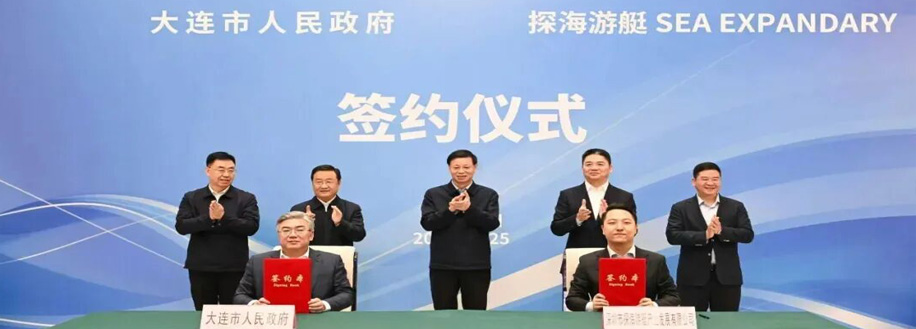
According to an official release from Dalian, on March 25, the Dalian Municipal Government signed a strategic cooperation agreement with Shenzhen Tanhai Yacht Industry Development Co., Ltd. The Tanhai Yacht Manufacturing Base and Yacht Operation Project, with a total investment of 15 billion yuan, officially settled in Dalian. Combined with the previously reported Sea Expandary brand planning, this signifies that Liu Qiangdong’s layout in the yacht industry has evolved from early-stage brand conception and regional positioning to a new phase of heavy-asset investment, manufacturing base construction, and operation system establishment. For China’s yacht industry, this represents more than just a single project launch; it likely signals a new acceleration phase for high-end yacht manufacturing, marine service consumption, and coastal scene operation.
Project Enters Substantial Implementation Phase
On March 25, the Dalian Municipal Government signed a strategic cooperation agreement with Shenzhen Tanhai Yacht Industry Development Co., Ltd. The Tanhai Yacht Manufacturing Base and Yacht Operation Project, with a total investment of 15 billion yuan, officially settled in Dalian. Xu Kunlin, Secretary of the Liaoning Provincial Party Committee, Wang Xinwei, Governor of Liaoning Province, and Liu Qiangdong, investor of Tanhai Yacht Industry Development Co., Ltd., attended the signing ceremony.
As previously reported by Sindh Marine Net in Liu Qiangdong: “Becoming a Captain Was a Childhood Dream”, in February this year, Liu Qiangdong, founder of JD Group, launched an independent yacht brand Sea Expandary, officially entering the yacht industry. He plans to build a full industrial chain covering R&D, manufacturing, sales, operation, leasing, brokerage, and services.
Previously, the public was more familiar with the English brand name Sea Expandary. However, according to the official release from Dalian, the actual industrial carrier and implementation platform of the project in China has clearly emerged as “Tanhai Yacht Industry Development Co., Ltd.” In other words, this is no longer merely a brand concept confined to press conferences and media reports, but a substantive project supported by local government agreements, industrial investment, project hosting, and follow-up implementation.
Notably, the scale of the Dalian project far exceeds initial market expectations. According to official sources, the total investment amounts to 15 billion yuan, covering not only customized high-end yacht production lines but also R&D, design, and manufacturing of large yachts and components, as well as operational facilities such as yacht urban salons, comprehensive service home ports, and yacht service hubs. This indicates that Tanhai is promoting not a simple shipbuilding project, but a systematic industrial plan centered on “manufacturing + operation + consumption scenarios”.
Dalian Becomes a Key Strategic Location
On the surface, Dalian is a new strategic move by Liu Qiangdong. From a deeper industrial perspective, however, this choice is hardly surprising. For a high-end yacht industry that combines both manufacturing and consumption attributes, Dalian holds a unique position among Chinese cities: it boasts a solid foundation in heavy industry and shipbuilding, enjoys the spatial conditions and marine resources of a coastal city, and has clear policy guidance for developing marine economy, cultural tourism consumption, and high-end manufacturing.
Especially at a time when China’s yacht industry is still immature and its upstream and downstream ecosystems have obvious shortcomings, a project aiming for large-scale development cannot rely solely on a “brand headquarters” or “sales operations”. It must find a city capable of supporting manufacturing capacity, supporting supply chains, and industrial collaboration. Dalian possesses exactly such capacity. The settlement of this project also suggests, to some extent, that Tanhai is not satisfied with being an asset-light consumer brand, but intends to build a genuine high-end yacht base supported by industry in northern China.
Dalian: Capable of Shipbuilding and Ecosystem Cultivation
In terms of manufacturing, Dalian’s most obvious advantage lies in its strong industrial foundation in shipbuilding and marine engineering equipment. As one of China’s traditional key shipbuilding industrial bases, Dalian has long maintained robust capabilities in ship design, construction, supporting systems, and engineering, giving it a stronger industrial foundation than many coastal cities known for consumption and services when undertaking large-scale, high-end, customized yacht production.
More importantly, Dalian’s value extends beyond “building factories and ships”. According to official statements, Dalian aims to accelerate the development of a high-end yacht manufacturing demonstration base and a marine leisure tourism destination on the basis of the two projects, drive coordinated development of the Liaoning Coastal Economic Belt, and build a full industrial chain ecosystem for yachts. This means local expectations for the project go beyond an industrial project plus a port project; they seek further expansion into high-end marine services, coastal consumption scenarios, integrated cultural tourism and commerce, and marine culture development.
From this perspective, Dalian and Tanhai are highly compatible. Tanhai needs not only land and factories but also a comprehensive urban platform capable of supporting manufacturing, exhibition, delivery, home port operation, maintenance services, and consumption scenario development. What Dalian hopes to gain is not merely an investment project, but a new growth point with spillover effects on marine tourism, high-end consumption, coastal economic belt linkage, and urban functional upgrading.
Notably, Xu Kunlin, Secretary of the Liaoning Provincial Party Committee, has long served in Jiangsu Province, and investor Liu Qiangdong also hails from Jiangsu. This overlapping “Jiangsu connection” has, to a certain extent, provided natural familiarity in industrial understanding and communication between the two parties. Fundamentally, however, the project’s settlement in Dalian is mainly attributed to the high compatibility between its shipbuilding industrial foundation and strategic positioning for marine economy.
More Than Yacht Manufacturing: Building a “Product–Scene–Service” System
From Liu Qiangdong’s earlier media statements to the details of the Dalian project, it is clear that Tanhai’s logic is not traditional “build and sell ships”. Instead, it seeks to establish a complete commercial system centered on high-end yachts: high-end equipment manufacturing at the front end, home ports, marinas, salons, and maintenance services in the middle, and yacht operation, leasing, services, and experiential consumption at the back end.
This is crucial. Unlike the automotive industry, which is driven largely by sales volume, the core of the yacht industry has never been the product alone. The development of the yacht industry often depends on mature scenarios, convenient supporting facilities, professional services, and lowered access barriers. Therefore, Tanhai’s simultaneous layout of high-end production lines, comprehensive service home ports, and urban salons reflects a clear strategy: not merely selling yachts, but long-term operation of a “maritime lifestyle”.
This also explains why the earlier remark of “making yachts affordable for wage earners” sparked controversy yet holds business logic. A realistic interpretation is not that ordinary families own yachts, but that yachts are transformed from high-end assets owned by a few into accessible marine service products through leasing, trusteeship, membership systems, tourism packages, and scenario experiences. From this perspective, the “operation projects” and “service hubs” in the Tanhai project are no less important than the manufacturing base itself.
Behind 15 Billion Yuan: Liu Qiangdong Bets on Two Major Sectors
Reducing this investment to “a tycoon cross-building yachts” underestimates its industrial significance. More accurately, Liu Qiangdong is betting on two overlapping sectors: high-end shipbuilding and marine consumption and coastal service economy.
On the manufacturing side, Liu Qiangdong previously stated that yachts represent “one of the last and highest-end blank areas” in China’s large industrial system. This judgment reflects a clear industrial upgrading perspective. While China leads globally in commercial ship manufacturing, it has long lacked globally recognized leading brands and mature ecosystems in high-end yachts, a sector integrating market-oriented branding, experience economy, and high-value-added manufacturing. If Tanhai can differentiate itself in new energy power, full automation, safety redundancy, and comfort, it will not only fill a niche industry but also address a clear shortcoming in China’s high-end ship consumer products.
On the consumption side, the outlook is even more promising. For yachts to expand from niche high-end consumption to broader service consumption, a complete service ecosystem is essential—including home ports, berths, maintenance, operations, membership systems, club activities, marine sightseeing, and tourism linkages. The repeated mentions of “yacht urban salon”, “comprehensive service home port”, and “yacht service hub” in the Dalian agreement confirm that the project bets not only on shipbuilding profits but also on future marine leisure consumption infrastructure and operational networks.
New Energy and Intelligence: Key Product Focuses
According to previously disclosed information, Tanhai’s planned yacht models will emphasize four core directions: new energy, full automation, enhanced safety features, and improved comfort. Among these, new energy and intelligence stand out as the most noteworthy.
New energy yachts attract attention not only for aligning with current policy and market trends toward sustainability but also for inherent advantages in user experience. Compared with traditional fuel yachts, electric propulsion systems offer quieter operation, lower vibration, and fewer emissions, making them ideal for high-end leisure scenarios and compatible with port city environmental requirements, offshore operation restrictions, and high-end clients’ sustainable consumption preferences. Liu Qiangdong earlier proposed using wind and solar energy for natural recharging on weekdays to support weekend usage. While this may not apply to all models, it demonstrates Tanhai’s intent to base its product narrative on a “new energy maritime lifestyle” rather than merely replacing traditional yachts.
Intelligence aims to lower operational barriers. Liu Qiangdong has expressed hope that future yachts will rely less on traditional captains and chefs and more on automated systems supported by service and safety personnel. Though aspirational, the essence is clear: transforming yachts from private assets requiring professional operation and heavy management into products suitable for standardized services, scalable operations, and lightweight user experiences. Success in this direction will lay a critical foundation for future leasing, club operations, and tourism integration.
A Rare “Systematic Investment”
A longstanding issue in China’s yacht industry has been its small market, fragmented investment, inadequate infrastructure, incomplete industrial chain, and immature consumption scenarios. Often, the industry lacks not demand or ambition, but systematic players willing to make long-term, heavy investments while integrating manufacturing and services.
In this sense, the Tanhai project stands out not only for its large investment but also for its comprehensive industrial strategy: using heavy investment to build manufacturing capacity, cooperating with cities to develop home ports and scenarios, and establishing operation and service systems to drive future consumption conversion. This approach is rare in China’s yacht industry, making its success or failure particularly noteworthy.
Of course, such systematic investment entails extraordinary challenges. High-end yachts follow neither pure manufacturing nor pure consumption logic; they require expertise in product development, marine scenarios, customer operation, and service standards, as well as coordination of local resources, port facilities, tourism systems, and industrial support. Thus, despite its implementation, the project remains at the start of its real challenges.
Liu Qiangdong Aims to Build More Than Yachts
From the initial Sea Expandary to the official settlement of the “Tanhai Yacht Manufacturing Base and Yacht Operation Project” in Dalian, Liu Qiangdong’s strategy has become increasingly clear: his focus extends beyond manufacturing high-end yachts to an entire emerging industrial space around marine consumption, marine culture, and high-end equipment manufacturing.
While China’s shipbuilding industry has established global competitiveness in large commercial vessels, marine engineering equipment, and green ships, future breakthroughs in high-end yachts, marine leisure equipment, and marine service consumption will represent another key area to watch. The success of the Tanhai project remains uncertain, but it has at least brought a once-niche industry into broader capital, policy, and public attention.